For small businesses, fighting against big brands is impossible. These companies have huge budgets for marketing and advertising. Moreover, professional management teams work for such giants to increase their presence on the market. However, with the advent of social media, everything has changed.
Now it has become possible to become successful on the Internet, even without millions of dollars in the budget. A small company with one of the social networks can now be a competitor of multinational corporations and create awareness about its brand. The main challenge in this process is to implement the correct social media marketing strategy.
This guide will explain how to develop a social media marketing strategy for small business to increase not only awareness about the brand but also find new customers and achieve sustainable growth in the long term. Now, companies can take full advantage of the opportunities offered by social media networks.
Why Social Media Marketing Matters for Small Businesses
In the 21st century, people no longer find information from newspapers and magazines. Today, the majority of users search online. That's why it's vital for any company to have a social media account. A competent strategy in this regard will help build recognition and popularity.
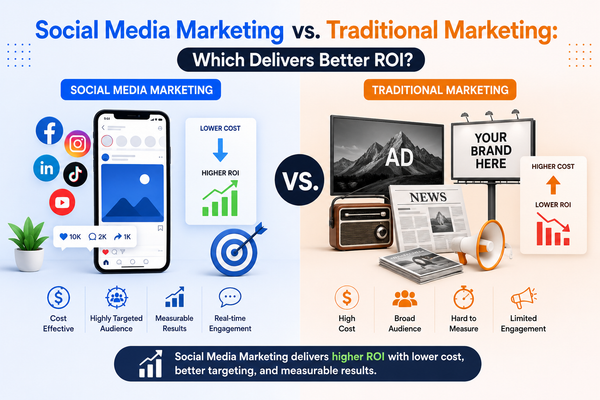
Moreover, using social networks, entrepreneurs can target their audience and increase sales. Another advantage of social media marketing is that it allows you to find qualified customers and retain them in the long run. Finally, it's much easier and more cost-effective to compete with giants using social media.
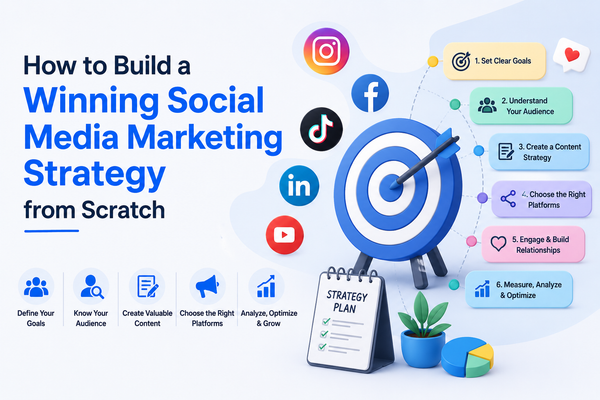
Building Your Social Media Marketing Strategy: Step by Step
1. Define Your Goals
Developing a social media marketing strategy should begin with a definition of the purpose and goals of the company in this regard. To do this, answer the following questions:
- Are you looking to increase your number of inquiries?
- Do you want to increase sales on your website?
- Is there a need to spread information about your business?
- Are you launching a new brand?
- Do you want to retain customers?
Only when a company has specific goals is it possible to measure the effectiveness of the results achieved.
2. Identify Your Ideal Customer
It's essential to define the ideal customer. First of all, this is necessary to build an effective strategy. In this context, small business owners should think about who their ideal customers are.
For example, how old are they, and where do they live? What interests do they have, and how much are they willing to spend on purchases? What problems are they looking to solve by working with the company?
With this information, it will be possible to select social media where the target audience spends time.
3. Choose the Right Platform
Now it's time to clarify which platforms to use for social media marketing strategy. There are several social networks, each of which is designed for a specific type of business.
Suitable for promoting beauty, fashion, restaurants, home decor, fitness, and cosmetics.
Great for local business marketing, organizing events, and customer service.
The most appropriate choice for professional communication and job searches.
YouTube
Perfect for educational purposes, product reviews, and creating useful content for customers.
Therefore, companies should choose the most suitable platforms without trying to be everywhere at once. It's better to take care of one social network and achieve specific goals.
4. Create Valuable Content
As the saying goes, nothing is given for free. This rule applies to social media marketing as well. Companies need to understand that for every result achieved on social media, they have to put in effort. First of all, it's vital to come up with high-quality content ideas and post them regularly.
Content Ideas That Work
- Useful information for customers
- Answers to frequently asked questions
- Product reviews
- Company achievements
- Tips and advice
- Promotional announcements
- Product introductions
The most important thing is that the content is beneficial in terms of educating the audience. After all, it's no secret that people get tired of advertising, so it's vital not to force customers to buy, but to help solve their problem.
Content Planning
Moreover, content ideas should be published at least several times a week. Companies should plan content in advance and have a calendar of publications so as not to miss regular posts. Today, there are many social media planners that small businesses can use to develop their own content calendars and plan the publication of materials.
5. Invest in Paid Advertising
The truth is that organic reach on most social media platforms has decreased. That's why it's vital for companies to learn how to reach as many target customers as possible by investing money in ads.
For example, Facebook and Instagram have a powerful advertising system that allows companies to promote their products and services to specific customers based on personal data, such as age, gender, location, and hobbies.
At the same time, a small business can invest money in ads only if they want to get high performance. Remember that the money should be spent on those who already know about the company and those similar to them, as well as those who have visited the website. In the end, a competent allocation of funds is needed to achieve high efficiency.
6. Engage With Your Audience
It's a mistake to believe that social media marketing means posting pictures and videos and waiting for customers to come to the company. However, many small businesses forget that social media marketing also includes engaging with the audience.
How to Engage Effectively
- Respond to comments and messages in a timely manner
- React to reviews and mentions on social media
- Answer questions promptly
- Provide qualified help when needed
After all, the ability to instantly respond to what customers are saying gives them confidence and loyalty to the company. The audience is also impressed by the response to questions and the timeliness of replies. In the end, everyone wants to receive answers to their questions and receive the most qualified help.
7. Generate and Nurture Leads
Thanks to social media, it's now possible to collect email addresses of potential customers, as well as interact with them to retain them. Moreover, there are several effective strategies for retaining customers on social networks. However, small business owners should take this issue to their hearts and be as close to the audience as possible.
Moreover, if the small company is not ready to maintain a dialogue with all visitors, it can invest in paid advertising to engage customers.
Measuring Success: Social Media Analytics
One of the main advantages of social media marketing is that the effectiveness of promotions can be measured. As a rule, the most important indicators for companies are the total number of impressions, engagement, and website traffic.
Key Metrics to Track
- Total number of impressions
- Engagement rate
- Website traffic
- Number of leads
- Conversion rate
- Followers growth statistics
- Cost of attracting one customer
Based on all the indicators, it will be possible to see what is working and what is not. In the end, only a competent analysis of social media marketing results can allow optimizing the strategy in the future.
Common Mistakes to Avoid
Unfortunately, when using social media for small business, many companies make mistakes that ultimately affect the results. Here are the most common ones:
Inconsistent Posting
The quantity and quality of materials must be such that all customers are engaged.
Ignoring Comments and Questions
Lack of response to comments and questions damages your brand reputation.
Not Investing in Paid Advertising
Relying solely on organic reach limits your potential growth.
Working Without Specific Goals
Spending time on social media without clear objectives wastes resources.
Copying Competitors
It's vital to develop your unique style rather than follow competitors.
Neglecting Existing Customers
Many companies forget that it's vital to use social media to retain already existing customers.
How AI Can Help Your Social Media Marketing
The emergence of artificial intelligence made the work with social media easier. This technology is used to plan content, schedule publication, collect information about customers, and analyze results.
At first glance, AI seems very promising for social media marketing. However, it's vital not to lose authenticity and creativity. After all, all these technologies are only a tool, and it's the person who has to decide what to do with them.
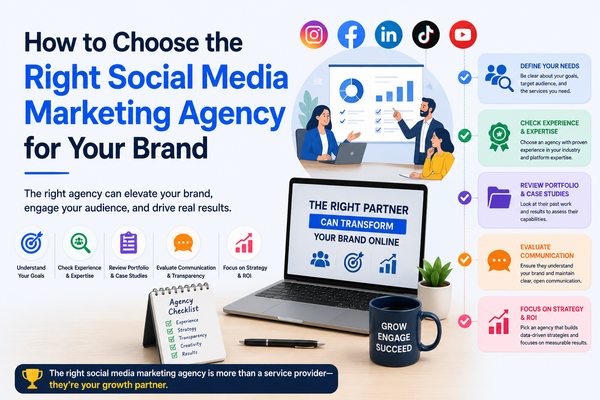
Should You Hire a Social Media Marketing Agency?
It takes a lot of time and effort to plan and implement a full-fledged social media marketing strategy. However, many small business owners do not have the time to do this because they have other responsibilities.
Benefits of Working With an Agency
Experience and Expertise
Working with an external agency will allow the company to benefit from the vast experience of specialists in this niche.
Time Savings
An agency will also take over some of the daily tasks, freeing up time for the company to focus on other areas of the business.
Professional Knowledge
An experienced agency knows all the nuances of social media marketing, and therefore will be able to plan and implement all activities correctly, taking into account the needs of the customer.
Thus, the company benefits from the high professionalism of the team and saves time.
To see if your campaigns are truly profitable, you need to closely track your performance marketing ROI.
Conclusion
Social media marketing is one of the most promising and accessible ways for small businesses to get to the market. However, to achieve real success, companies need to invest in developing and implementing the right strategies.
The most important thing in social media marketing is to understand exactly who the target audience is, communicate with it consistently, and invest in high-performing content. Only a competent approach to this work allows a small business to grow on the Internet, gain new customers, and generate more revenue.
Frequently Asked Questions
1.Why is social media marketing important for small business?
With the advent of social media, the possibility of fighting with big brands became available to small business owners and start-ups. Today, companies have many opportunities to increase sales, build brand awareness, and retain customers using social networks.
2.What social media is best for small business?
Depending on the company's needs and audience, this can be Instagram, Facebook, YouTube, or LinkedIn. Each of these social networks has its advantages and is designed for specific purposes.
3.How much should small business spend on social media marketing?
The amount varies depending on the company's needs and marketing goals. However, the initial budget can be small, since many small businesses have limited resources.
4.How often should small business post on social media?
Publishing content several times a week is better than posting every day. The fact that the publication is high-quality, engaging and informative is more important than the frequency of publication.
5.Should a small business hire a social media marketing agency?
Some companies lack the expertise or time to manage their social media accounts efficiently. In this case, it makes sense to entrust this responsibility to professionals who will create a winning strategy and ensure the company's growth in social media.
Work With Evolve Digital
Want results like these for your brand?
We help brands grow with SEO, paid media, and ecommerce strategy that actually converts. Tell us your goals and we'll map your next stage of growth.
Book a Free Strategy Call